
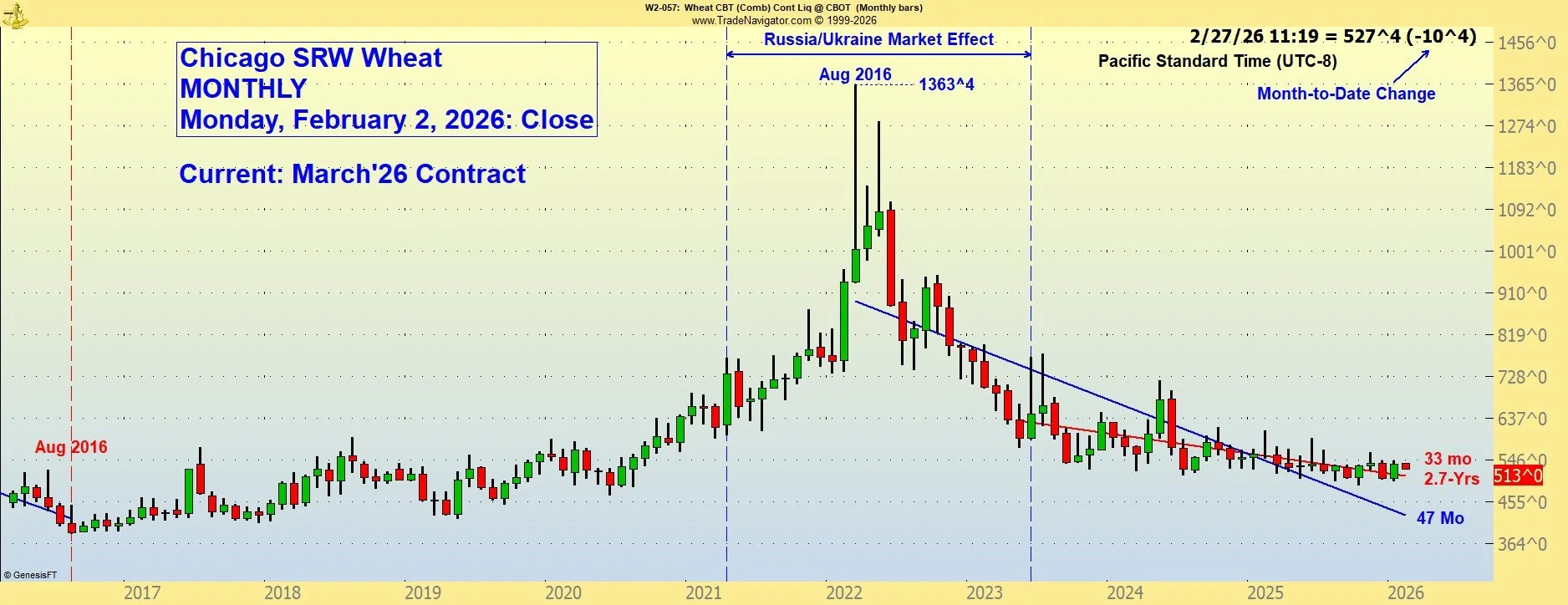
Monthly Chicago SRW 4-Year and 2.5 Year Mean
and Global Wheat Export Fundamental Price Factors for the Next Decade of Trade
Global Supply and Demand Dynamics
Tightening Global Supplies: Weather events or geopolitical instability in the Black Sea tributary region (Russia, Ukraine) could lead to lower production or smaller beginning stocks in any given crop year.
Rising Global Demand: Population and income growth in developing countries, particularly in Africa (North and Sub-Saharan) and Southeast Asia (Indonesia, Philippines, Vietnam), are expected to drive sustained import demand, providing significant market opportunities for U.S. exporters.
Strong U.S. Production: Favorable domestic weather conditions and improved crop management leading to strong yields and larger U.S. supplies would put downward pressure on U.S. prices, making them more competitive on the world market.
Trade and Policy Factors
Favorable Currency Exchange Rates: A weaker U.S. dollar would make U.S. agricultural products more affordable for international buyers, boosting export demand and competitiveness.
Trade Agreements and Market Access: New or expanded bilateral trade agreements with various countries could provide preferential market access and reduce trade barriers, supporting U.S. exports.
Market Development and Technical Assistance: Ongoing market development work by organizations like U.S. Wheat Associates (USW), including technical assistance and securing long-term purchase commitments (e.g., MOUs with countries like Indonesia), helps build familiarity and a preference for U.S.-grown wheat among international buyers.
Domestic Factors
Technological Advancement: Continued investment in agricultural research and development to improve wheat varieties (e.g., disease resistance, quality traits) and sustainable farming practices could increase productivity and quality, enhancing the U.S. position.
Stabilizing Acreage: The U.S. has seen declining wheat acreage in recent years; if farmers can be incentivized to maintain or increase planted area (possibly influenced by price relationships with other crops like corn and soybeans), it would ensure a sufficient exportable surplus for future years.